
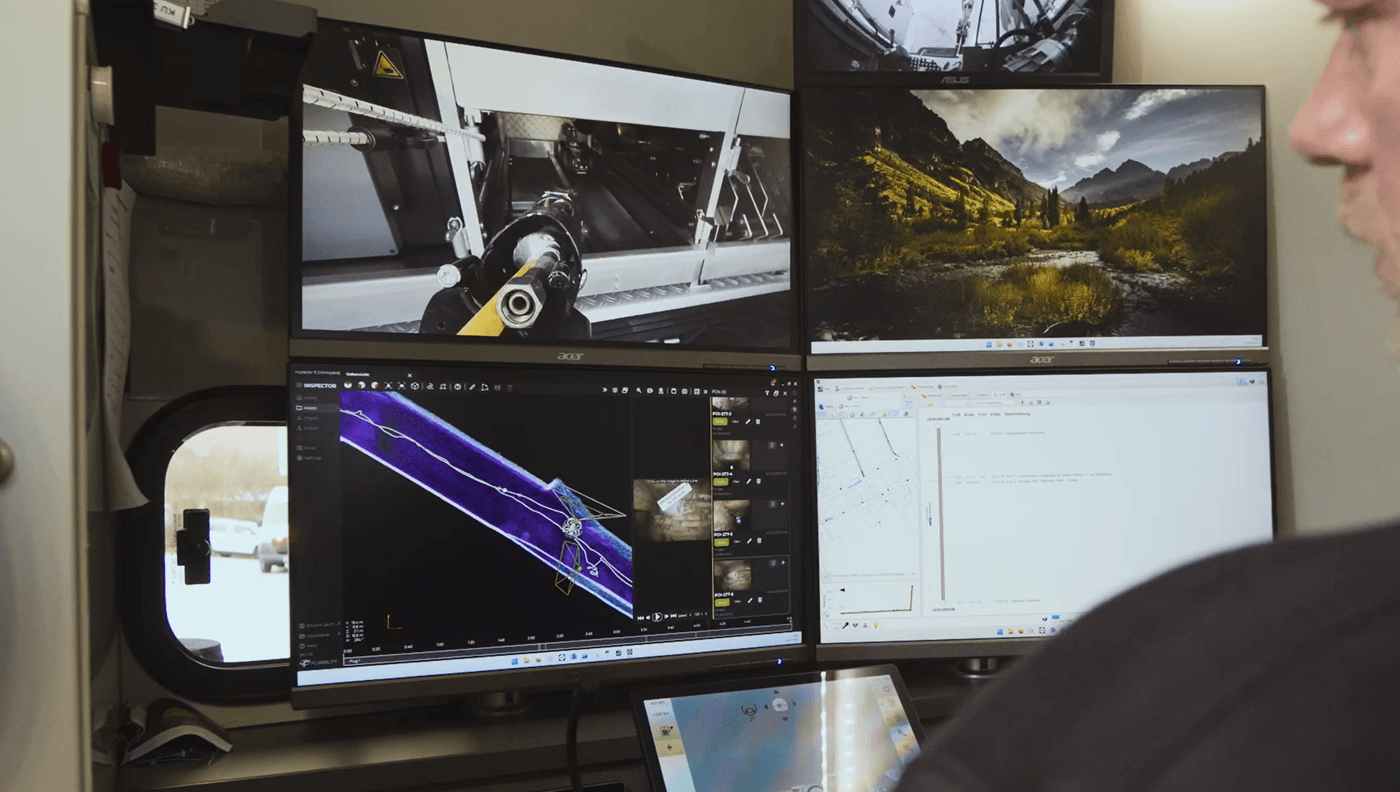
Standard-compliant condition assessment for your sewer network
The results of the sewer inspection are professionally processed, comprehensibly documented and made available for further planning. Depending on the project requirements, reports, image documentation, condition assessments and exchange data can be created in suitable formats such as ISYBAU XML, DWA-M 150, TV-Kandis-compatible formats or other interfaces.
Based on the recorded inspection data, we create a structured condition assessment for sewers, manholes, culverts and special structures. Damage, abnormalities, deposits, deformations and other findings are documented in a comprehensible manner and prepared for further technical assessment.
Depending on the project requirements, the assessment can be based on relevant regulations such as DIN 1986-30, DIN EN 13508-2 and DWA-M 150. This results in reliable reports and digital data that can be used as a basis for rehabilitation planning, prioritization, documentation and coordination with clients, municipalities or network operators.
As an experienced specialist company in the field of sewer inspection, sewer cleaning and sewer rehabilitation, Kuchler combines proven practice with modern digital data acquisition and evaluation.
Typical areas of application
The condition assessment and reporting supports operators, municipalities, engineering offices, industrial companies and private clients in the comprehensible assessment of their drainage infrastructure.
How your project works
From data collection to handover of the results, you receive a comprehensible basis for evaluation, documentation and further planning.</p
FAQs
What does the condition assessment during a sewer inspection include?
The condition assessment includes the technical processing of the recorded inspection data for sewers, manholes, culverts and special structures. Damage, anomalies, deposits, deformations and other findings are documented in a structured manner and described in a comprehensible manner. The aim is to create a reliable basis for further technical assessment and planning. Depending on the project requirements, the results can be based on regulations such as DIN 1986-30, DIN EN 13508-2 and DWA-M 150. This creates a reliable basis for rehabilitation planning, prioritization and coordination with clients or network operators.
Which output formats are possible for reporting and data transfer during sewer inspections?
Depending on the project, various suitable formats can be provided for reporting and data transfer. These include reports, image documentation, condition assessments and exchange data in formats such as ISYBAU XML, DWA-M 150 or TV-Kandis-compatible interfaces. The selection of formats is based on the requirements of the project and the specifications of the processing departments. This allows the results to be efficiently integrated into existing systems and planning processes. A structured digital transfer facilitates the documentation, evaluation and further processing of the inspection data.
Which standards and regulations are used to assess the condition of sewers and manholes?
The condition assessment can be based on relevant standards and regulations that are decisive for the assessment of drainage infrastructure. In particular, DIN 1986-30, DIN EN 13508-2 and DWA-M 150 are mentioned on the page. These regulations create a comprehensible basis for the structured recording and assessment of damage and findings. This ensures that the results are technically reliable and comprehensible for the various parties involved. This is particularly important when reports are used as a basis for rehabilitation decisions, prioritization or coordination with local authorities and network operators.
For whom is a structured condition assessment and reporting useful?
Structured condition assessment and reporting is useful for operators, local authorities, engineering offices, industrial companies and private clients. It helps to assess the condition of sewers, manholes, culverts and special structures in a comprehensible manner. Reliable reports and digital data are particularly important when planning renovations or prioritizing measures. Standard-oriented processing also offers clear advantages for internal documentation and coordination with clients or network operators. This provides all parties involved with a uniform and reliable basis for decision-making.
How does a project for condition assessment and report preparation for sewer inspections work?
A project begins with a review of existing inspection data or new data to be recorded and clarification of the specific requirements. The appropriate output formats for reports, image documentation, condition assessments and exchange data are then agreed. Based on the recorded data, the findings for sewers, manholes, culverts or special structures are then processed in a structured, technical manner. The results are documented in a comprehensible manner and made available for further planning. A project-related offer with a fixed price and an on-site appointment are also available on request.
Why Kuchler Geomatics Condition Assessment & Reporting?
Kuchler Geomatics combines proven practice in the field of sewer inspection, sewer cleaning and sewer rehabilitation with modern digital data acquisition and evaluation. This results in comprehensible condition assessments and structured reports that are geared towards the requirements of the respective project. The company prepares inspection data professionally and makes it available in suitable formats such as ISYBAU XML, DWA-M 150 or TV-Kandis-compatible interfaces. This provides clients with a reliable basis for documentation, renovation planning and prioritization. In addition, requirements are quickly checked, suitable output formats are coordinated and, if required, an offer can be prepared within 24 hours.
Talk to us about your requirements for condition assessment, report generation and data transfer
We check the existing data or data to be newly recorded, clarify the appropriate output formats and, if desired, prepare a project-related offer.
Response within 24 hours - Fixed price offer possible - On-site appointment on request